

Story · Journey · UK Boat — Episode 001
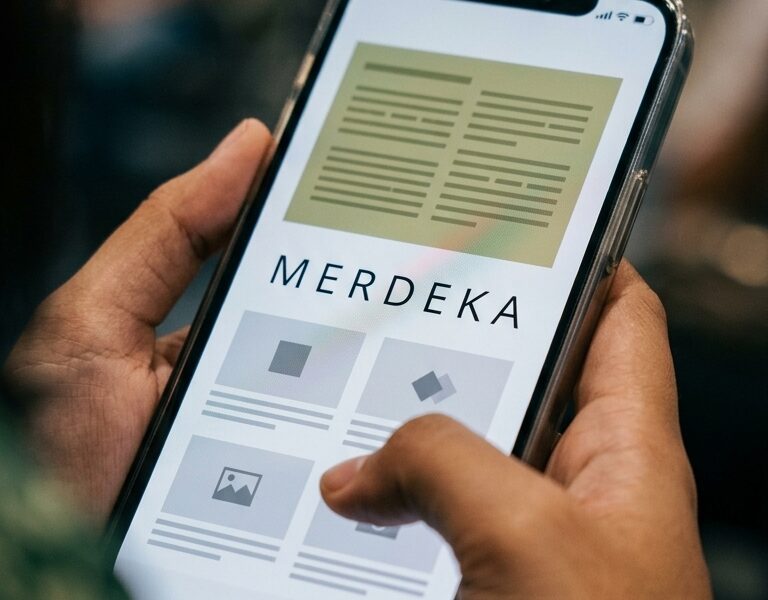
Merdeka
The Word on the Water
Synopsis
At 11:07 on a Friday night in September 2026, a volcano in the Sunda Strait cleared its throat, and a quarter of a million people stopped going anywhere.
One of them was a twenty-three-year-old woman sitting on the floor of Terminal 3, Soekarno–Hatta, with a one-way ticket to Birmingham, a jar of her father’s sambal wrapped in three plastic bags, and a hashtag she was beginning to regret. At 11:48 p.m. she sent her father the kind of question nobody should have to answer before midnight:
Pak, am I a traitor for leaving?
He did not answer. So she did what everyone does on an airport floor at midnight: she searched. She typed the name of the city she was flying to, and the name of the country she was leaving, and the internet gave her back something she had not asked for. A short note, written by an Indonesian runner on the morning of 5 September 2015 — eleven years earlier, to the day — about a narrowboat moored on a black canal in the middle of England, with a word painted on its side.
Her word. The first word her country ever learned to shout.
The note was four sentences long. It did not say who had painted the word there, or why. Nobody knows.
She was about to land in the only city on Earth where someone still might.
Chapters
- PrologueThe Volcano Clears Its Throat
- Chapter OneThe Record
- Chapter TwoFour Phone Calls
- Chapter ThreeWhat the Word Used to Mean
- 📅 Chapter Four — The Auntie from Blitar — tomorrow
Prologue
The Volcano Clears Its Throat
The volcano did not know anyone’s plans.
This is the first thing to understand about the night of Friday, 5 September 2026, and it is the thing nobody in Terminal 3 could bring themselves to understand for at least the first two hours. Anak Krakatau — the child of Krakatoa, the island that rose out of the sea in 1927 where its mother had blown herself into the sky — began to erupt at seven minutes past eleven, local time. Nobody in the departure hall heard it. Nobody felt it. The sky above Tangerang looked like any other Jakarta sky at night: orange at the edges, starless, faintly humming.
And then, one after another, the words on the departure board began to change.
DELAYED. DELAYED. DELAYED.
Then, a little after half past eleven, as if the board had simply lost its patience with everybody: CANCELLED.
Laras Ayuningtyas was sitting on her suitcase near Gate 7 when the flight to Doha turned red. She was twenty-three. She had a Master’s scholarship to the University of Birmingham, a visa stamped into a passport that still smelled of the photocopy shop, a backpack full of chargers, and — wrapped inside a supermarket bag, inside a second supermarket bag, inside a third, because her father trusted plastic the way other men trust God — a jar of sambal bawang made at four o’clock that afternoon in a kitchen in Surabaya.
She looked at the board. She looked at the people around her beginning to stand, the way a field of grass stands when a wind it cannot see arrives. She heard a man behind her say “Gunung? Gunung apa?” and a woman answer “Krakatau, Pak, di berita,” and she thought, with the absurd clarity that arrives only at the very worst moments: Of course. Of course it’s a volcano. Nothing in my life has ever been allowed to leave quietly.
She did not cry. She wants that on the record. She sat down again, on the floor this time, with her back against a pillar, and she opened her phone, and she did the thing every twenty-three-year-old in the world now does when the ground moves under them.
She read the comments.
Seven months earlier, in February 2025 — before the scholarship, before the visa, before any of it was real — Laras had posted a thread on X under a hashtag that half the country was using that week: #KaburAjaDulu. Just leave first. Figure out the rest later. It had been a joke, mostly. Mostly a joke. A list of ten reasons, written at two in the morning after her father came home from his eleventh hour on the motorbike and fell asleep in his jacket at the kitchen table. Reason number seven had been because I’m tired of watching the people I love work until they fall asleep sitting up. That one was not a joke.
The thread had travelled further than she had ever travelled. Forty-one thousand likes. Nine thousand quote-posts. A news portal had screenshotted it under the headline GEN Z RAMAI-RAMAI INGIN KABUR: SUDAH HILANGKAH NASIONALISME? — Gen Z Wants Out: Is Nationalism Dead? — with her face blurred, badly. Her aunt in Lamongan had recognised the blurred face. So had her aunt’s WhatsApp group.
Tonight, because someone had found her again and because the internet never throws anything away, the replies had come back to life under her old words like mould under wallpaper.
Kabur pakai beasiswa uang rakyat. Mantap.
Pengkhianat. Jangan pulang sekalian.
Semoga gunungnya tahu diri.
That last one was new. Someone had written it forty minutes ago. Hopefully the volcano knows its place.
She laughed, once, the way you laugh when something is not funny at all, and a little girl across the aisle looked at her, alarmed.
Then she opened the chat with her father. It was the chat she used least and read most: a long column of his messages, almost all of them the same three words — Wis mangan, Nduk? Have you eaten, child? — sent at six in the morning, at noon, at nine at night, never with a full stop, never with an emoji. She typed, deleted, typed again, and sent:
Dad, my flight’s cancelled. Krakatau’s erupting. I’m at the airport, I’m safe. Dad, I want to ask you one thing. Answer honestly. Am I a traitor if I leave?
Two grey ticks.
They stayed grey. In the house in Surabaya, her father was asleep in his jacket in front of the small television, and his phone was on the kitchen table, face down, where he always left it so that its light would not wake him.
She waited five minutes. Then ten. Then, because you cannot sit on the floor of an international airport at midnight looking at two grey ticks forever, she did the other thing everyone does.
She searched.
She did not know what she was searching for. She typed Birmingham Indonesia, because it was the city she was going to and the country she was leaving, and because some part of her wanted proof that the two words had ever belonged in the same sentence. The internet gave her what it always gives: a university page, a travel blog, a student association, a halal restaurant with four and a half stars. And then, on the second page, something she had not expected. A long list of boats. Boats with names. UK Boat, the list was called: a collection of four hundred and thirty-two narrowboats photographed along the canals of Birmingham between 2015 and 2017 by an Indonesian who had lived there.
Number one was at the top.
She read the date first, because the date was the thing her eyes were hungry for. 5 September 2015.
She looked at the clock on her phone. 23:52. 5 September 2026.
Eleven years ago. To the day.
Then she read the name of the boat, and put her hand over her mouth, and the little girl across the aisle looked at her again.
The boat was called Merdeka.
Chapter One
The Record
This is the part of the story that belongs to me, so I will tell it the only way I can tell it honestly: exactly as I recorded it, and no further.
Between 2011 and 2017 I lived in Birmingham, and in those years I ran. I ran along the canals — ten kilometres on an ordinary morning, twenty-two on an ambitious one — on the towpaths that wind through the middle of the city a storey below the streets. And on those runs I began to notice the names of the boats — because every narrowboat on the English canals carries a name, painted on its side by someone who chose it — and then to photograph them, and then to write a line or two about each one, and number them. By the time I left, there were four hundred and thirty-two.
Number one was Merdeka. Here is everything I wrote about her, word for word, on the day:
When I was jogging on 5 September 2015 along Birmingham canals, around Cambrian Wharf, I spotted this lovely boat. And her name is Merdeka. Merdeka means freedom, it’s our Indonesian national slogan from the time of independence struggling up to now. What a lovely moment!
Beside it, the name of the photograph: DSC00372.
That is the whole record. Four sentences and a file name.
I have been tempted, many times since, to add to it. A storyteller always is. It would be easy to tell you the colour of the morning, a heron on the far bank, what I felt in my chest, whether I knocked on the door of the boat, who answered, what they said. People would believe me. Some of it might even be true.
But I did not write any of it down, and eleven years is long enough for memory to start painting its own pictures and signing them with my name. So I will not tell you those things. What I can tell you is what the record already says, if you listen to it carefully.
It says lovely, twice — this lovely boat, what a lovely moment — which is not the word of a man who is composing a story. It is the word of a man who has just seen something that made him happy and does not want to make it more complicated than it is.
It says our. Our Indonesian national slogan. Not the. The first person plural slipped into an English sentence, in a city where, for years, almost nothing had been ours.
It says from the time of independence struggling up to now — which is imperfect English, and I have left it imperfect, because it is also exactly right. The struggle did not end in 1945. It is up to now. It is still going.
And it gives a place and a date. Around Cambrian Wharf. 5 September 2015.
Cambrian Wharf is a small basin at the top of the Farmer’s Bridge locks, where the water widens and boats moor in a row beneath the flats. The date was a Saturday. Nineteen days earlier, on 17 August, Indonesia had turned seventy.
That is all. There is no owner in the record. No conversation. No explanation of why a boat on an English canal should carry, painted along its side, the word that an entire archipelago once shouted at the end of a war. The record is a door, not a room. It opens, and you can see the word, and then it stops.
Every Indonesian who reads that note asks the same question immediately. It does not need writing down. Laras asked it on the floor of Terminal 3, with her hand over her mouth, eleven years later.
Who?
Chapter Two
Four Phone Calls
In Terminal 3, it was a quarter past midnight on Saturday, 6 September 2026, and Laras had not moved from her pillar. Around her, the departure hall was slowly reorganising itself into a small, temporary city. It happens every time. Put enough stranded Indonesians in one place for long enough and a village will spontaneously form, the way crystals form in a glass of sugar water: a man had produced a portable speaker from somewhere and was playing dangdut very softly, as if in apology; three students in matching university jackets had built a fortress out of their suitcases and were playing cards inside it; a grandmother in a batik headscarf was distributing kacang from a large plastic jar to anyone who came within range, whether they wanted it or not.
Laras had accepted the peanuts. You do not refuse a grandmother at an airport. It is not safe.
She had read the four sentences about the boat eleven times. She had scrolled through the list of names beneath it — Joseph, Just Perfick, Escapology, Saoirse, Journeyman, all the way down to four hundred and thirty-two — and felt, absurdly, as if someone had left the lights on for her in a house she had never visited. She had tried to imagine the man who had written what a lovely moment! on a Saturday morning in a foreign city, and found that she could not, and that she did not need to. The word was enough.
Merdeka. On a boat. In Birmingham. Eleven years to the day before a volcano stopped her going there.
Then the phone rang, and it was her father, and the boat went out of her head.
He had woken at midnight — he always woke at midnight, for no reason, and then slept again — and seen the news on the television he had left on, and turned his phone over, and seen her messages. He did not mention the last one. He asked whether she was safe. She said yes. He asked whether she had eaten, and she lied and said yes. He asked whether there was anywhere to sleep, and she said the airline would find a hotel, which was not yet true.
Then he did not say anything at all for almost a minute, and she listened to him breathing and to the sound of the television behind him, and then he said, in Javanese, the way he only ever spoke when something mattered:
“Nek ra sido mangkat, yo mulih wae, Nduk.”
If you don’t end up leaving, just come home, child.
And she said, “Iya, Pak,” and he hung up, and she sat very still for a while.
The thing is, she did not know what he meant by it. That was the problem. That was the problem with her father, and had been her whole life. Darsono Wibisono had worked for nineteen years at a textile factory in Sidoarjo, running the same machines on the same shifts, until the spring of 2025, when the factory — like so many that year, one after another, like a row of lights going out down a long corridor — had closed its gates and posted a notice on them in a font too small to read from the road. He was fifty-one. He had come home that afternoon, sat down at the kitchen table, and asked Laras to help him download an app.
By the end of the week he had a green jacket and a green helmet and a phone mounted on the handlebars of the same old motorbike he had ridden to the factory for nineteen years. He drove passengers and parcels across Surabaya from six in the morning until the numbers on the app told him he could stop, which was often after ten at night. He never complained. Not once. Not about the heat, not about the rain, not about the customers who cancelled after he’d waited twenty minutes, not about the rating system that could take away a day’s bonus because someone was in a bad mood. He came home, he ate, he fell asleep in his jacket, and in the morning he was gone before she woke up.
When she won the scholarship — a real one, the full one, tuition and living costs and the flight — he had not said congratulations. He had not said I’m proud of you. He had gone very quiet, and then gone out, and come back an hour later with a cake from the bakery on the corner, the expensive one with the cream roses, and put it on the table, and said, “Lho, dimakan” — well, eat it, then — and gone to take a shower.
When the thread went viral, and her aunt from Lamongan phoned the house to ask whether he knew his daughter was ashamed of her own country, he had listened politely for eleven minutes, said “Nggih, Mbakyu, nggih” — yes, sister, yes — nine times, and then hung up and never mentioned it to Laras at all.
And that afternoon — the afternoon of the day the volcano did not yet know about — he had stood in the kitchen at four o’clock frying shallots and garlic and bird’s-eye chillies in a wok that was older than she was, and filled a jar, and wrapped it in three plastic bags. And at the airport in Surabaya, before her connecting flight to Jakarta, when she had turned at the security line to wave, he had pressed something into her hand that she had not looked at until she was on the plane.
A flag. A small one. Red and white, on a plastic stick, the kind that street sellers sell in their thousands every August at every traffic light in Indonesia. A little faded. There was a crease across the middle where it had been folded for a long time.
She had been, if she was honest, embarrassed. It was so obvious. So August. She was going to Birmingham to study machine learning, not to march in a parade. She had put it in the side pocket of her backpack, face down, like a thing that might go off.
It was still there now, against her hip, as she sat against the pillar in Terminal 3 with the ash of a volcano drifting somewhere over her head. She could feel it through the fabric.
If you don’t end up leaving, just come home.
Was he glad? Was he sad? Did he want the volcano to win?
She did not know. She looked down at her phone, where the four sentences about the boat were still open, and she read the last four words again — what a lovely moment! — and thought that whoever wrote them had probably never had to wonder, on the floor of an airport, whether his own word still belonged to him.
Then she scrolled further down the page, looking for the rest of the story. There was no rest of the story. There was only the note, and the date, and the file name, and the word.
So she opened a new tab, and typed merdeka, and for the first time in her life, she looked it up.
Chapter Three
What the Word Used to Mean
Here is something they do not teach you in primary school, when you are standing in the heat on a Monday morning with a paper flag, shouting.
Merdeka is not an Indonesian word. Not originally.
It came, like so many of the words we think of as most intimately ours, from somewhere else. It began its life in Sanskrit, a very long time ago, as maharddhika — a word that meant something like great in prosperity, powerful, eminent. A word for the fortunate. A word for people who had a lot. It travelled, the way words travelled then, on ships and in the mouths of traders and priests and poets, across the Bay of Bengal and down the Strait of Malacca, and somewhere in the long centuries of that journey it wore down, as words do, and softened, and became merdehéka, and then merdeka, and its meaning began, very slowly, to change.
It came to mean free. But not free the way we mean it now — not free as in independent, not free as in a nation standing up in the sun. It meant free as opposed to owned.
When the Dutch East India Company built its fortress town of Batavia on the north coast of Java in the seventeenth century, it filled the town with enslaved people from all over the Indian Ocean world — from the coasts of India, from Bengal, from Sri Lanka, from the islands of the east. Some of them, over the years, were freed: by conversion, by purchase, by the death of an owner who had written it into his will. These freed people formed their own community, spoke their own Portuguese-based creole, built their own church, and they were called — by the Dutch, who borrowed the local word and bent it into their own mouths — the Mardijkers.
Mardijker. From merdeka. It meant, quite simply: a person who used to belong to someone else, and now does not.
Their descendants are still there. In Kampung Tugu, in North Jakarta, in the shadow of the container port, in a neighbourhood most Jakartans could not find on a map, there is a small community that still plays a music called keroncong Tugu on ukuleles and guitars — the same slow, swaying, heartbreaking rhythm that would later drift out of Tugu and into the radios of the whole country and become the sound of Indonesian nostalgia itself. The first keroncong was the music of freed slaves. Think about that the next time you hear it at a wedding.
It is like finding out that a coat you have worn every day of your life was sewn from someone else’s flag. It does not make the coat less yours. It makes it heavier.
And there is more.
Our merdeka — the shout, the raised hand, the reflex — was born on a precise date. After the Proclamation, the young Republic needed a greeting, a way for its citizens to recognise each other in a country that had, until a few weeks earlier, not been allowed to exist. One of the founding fathers, a Sundanese nationalist named Oto Iskandar di Nata, is said to have paced his house with his fist in the air shouting “Indonesia merdeka!” — and been told it was too long. So it was shortened. And on 31 August 1945, the government issued an announcement: from the first of September, citizens would greet one another with a single word, one hand raised to shoulder height, palm open, five fingers for the five principles.
Merdeka!
Continue to echo this cry, the announcement said, as the echo of a free soul. A soul that struggles and works. Struggle, and work. Prove it.
And then — this is the part that stopped Laras cold, on the floor of Terminal 3, with a peanut halfway to her mouth — twelve years later, on another thirty-first of August, 31 August 1957, in a brand-new stadium in Kuala Lumpur, under floodlights, before a crowd of tens of thousands, a man named Tunku Abdul Rahman stood up at the moment his country became independent of Britain, raised his right hand, and shouted a word seven times.
The same word.
Merdeka! Merdeka! Merdeka! Merdeka! Merdeka! Merdeka! Merdeka!
The stadium is called Stadium Merdeka. Malaysia’s national day is called Hari Merdeka. It falls on the thirty-first of August.
Which means that on 5 September 2015 — the Saturday in the note — Malaysia had celebrated the fifty-eighth anniversary of its Merdeka just five days earlier. There are tens of thousands of Malaysians in the United Kingdom. There are Malaysian students in every university in Birmingham. There are Malaysian families who came in the sixties and seventies and never left.
The boat, in other words, might not have been Indonesian at all.
Laras felt, reading this, a small, sharp, absurd pang, which she recognised after a moment as the feeling of being robbed — as if she had found something precious lying in the road, and picked it up, and held it to her chest, and then seen someone else’s name written on the back. It was ridiculous. She knew it was ridiculous while she was feeling it. Our two countries are neighbours, siblings, cousins who squabble at every family gathering about who invented rendang and whose batik is whose. We share a language that was, for most of its history, one language. We share a sea. We share, it turns out, the very word we thought was the most ours.
And within a minute of feeling robbed, she felt ashamed of feeling robbed.
Because what kind of freedom is it that can be owned? What kind of merdeka gets jealous?
The Mardijkers of Batavia would have laughed at her. They knew better than anyone what the word was for. It was never a flag. It was never a border. It was a state that one human being could pass into, from another state that was worse. It was a door.
It was the door itself.
↑ Back to the chapters · Profitina