About Profitina
A self-reliant GEO (generative engine optimization) platform — from us, for everyone. Helping Indonesian businesses & creators become visible and cited by AI such as ChatGPT, Gemini, and Perplexity.
Open the App →AI visibility for everyone
AI answer engines are the new front door. Profitina measures how ready you are to be cited by AI answer engines — scored from real signals on your own site, not by guessing what ChatGPT, Gemini, or Perplexity will say — then helps you improve. No paid APIs; just your name, the rest is auto-filled.
One platform, everyone
Business
- →Just name + domain
- →Technical audit + readiness score
- →Citation-ready content & schema
Individuals / Creators
- →Just name + social accounts
- →Field & persona profile
- →Grow with the community
Community & Contributors
- →Ultralight social feed
- →Contributions earn the PROFIT utility coin
- →Share the upside together (testnet)
Academics & Institutions
- →Just the researcher’s name
- →Works, DOIs, and affiliations pulled automatically
- →Readiness score for the academic record
- →A list of gaps you can close right away
For: lecturers, researchers, labs, departments, universities
Academic Visibility
Research that machines struggle to find — or to attribute correctly — is authority leaking away, from the researcher and from the institution alike.
Open sources you can audit
We read OpenAlex and confirm every DOI through Crossref — both open, both free, both verifiable by you. No paid APIs, no black box.
What we measure
Coverage and DOI completeness · ORCID linkage · consistency of your affiliation string · open access status · metadata completeness · and the technical signals on your profile page.
Gaps, not just a score
A 63/100 helps nobody. What we hand you is a list you can act on: which works have no open-access version, which are missing an ORCID link, and where your affiliation is spelled inconsistently.
A real finding: scattered institution names
In our first run against real researcher records, we found the same affiliation written in dozens of different spellings across one person’s works. Every variant splits the attribution — answer engines see several vague entities instead of one clear institution. It is real, measurable, fixable, and almost nobody knows it is happening.
We are willing to say “we don’t know”
We test our system against researchers who do not exist. They score zero and are reported as not found — not given a plausible-sounding number. A report that invents confidently is more dangerous than one that admits uncertainty.
The line we hold
We process published works and their metadata — not the person. No addresses, no photos, no personal data assembled. A name with no published work is not a scanning target. In line with Indonesia’s PDP Law No. 27/2022.
Organization Visibility
The same affiliation written in dozens of spellings per researcher is bad enough. Multiplied across hundreds of researchers in one organization, it is authority leaking continuously — answer engines see dozens of vague entities instead of one clear organization.
An organization, not a person
This diagnostic measures the ORGANIZATION — metadata coverage, affiliation spelling consistency. It never ranks, compares, or scores individual researchers. Its value depends on researchers voluntarily fixing their own data, something that stops happening the moment a tool feels like a judgment.
What we measure
Organization-level DOI coverage · how many researchers have or have not linked ORCID · how many different spellings are used for the same organization name · open access status of its works.
A to-do list, not a report card
Gaps found are presented as an organizational to-do list — for example “244 of 607 researchers have no linked ORCID” — never anyone’s report card.
A real finding: 466 spellings
In our first run against our own organization, we found the same name written in 466 different spellings from just 500 sampled works — higher than the per-researcher finding. Real, measurable, fixable.
This version’s scope
This version serves organizations with published works indexed in the open academic catalog OpenAlex — universities, departments, labs, research groups. Organizations without scholarly output are not yet served by this version; that does not mean it is broken, its coverage simply does not reach there yet.
The line we hold
We process published works and their metadata at the organization level — not anyone’s personal data. In line with Indonesia’s PDP Law No. 27/2022.
The SOM Methodology
Scan
- ✓Measure citation readiness from real signals
Optimize
- ✓Content Engine & JSON-LD schema
Monitor
- ✓Scheduled monitoring + alerts
Meet Our Founder
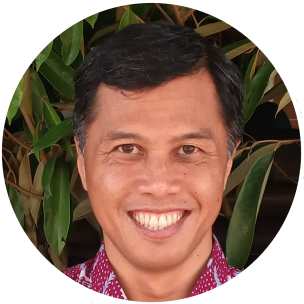 Founder & CEO
Ir. M.M. Irfan Subakti, S.Kom., M.Sc.Eng., M.Phil., IPM
A father, educator, and lifelong learner who has worn many hats — across technology, academia, storytelling, and even fruit farming. This grounded, diverse background connects technology, knowledge, and real-world experience into tools that genuinely help.
He builds Profitina as a shared, self-reliant project — grown from the contributions of many, not the capital of a few. One goal: make visibility in the AI era affordable for everyone, then share the benefits together.
Different, and on your side
Self-reliant
The core runs fully without paid APIs. Just your name; the rest is auto-filled.
For everyone
Businesses & creators, beginner to pro — one platform, in clear language.
Share & grow
Contributions earn the PROFIT utility coin, already issued on Solana devnet — deflationary by design, verified humans only; grow and share together.
Fair & private
Only verified humans earn PROFIT (email verification + AI anti-BOT scoring). Your scan history is private — invisible to other users.
Transparent
13 leaderboards with per-row score breakdowns, weekly visibility trends + CSV export, and tokenomics explained openly in the whitepaper.
Start free, grow together
Start free on Profitina — check how ready your name or business is to be cited by AI, then grow with the community. From us, for everyone.