How to Spot a Scam Before It’s Too Late—And What One Platform Is Doing Differently
A reader we will call Jessika thought she had found her ticket to financial freedom. The crypto project promised 300% returns in just six months. The founders? Faceless. The roadmap? Vague. The hype? Off the charts.
Three months later, her $5,000 investment vanished overnight.
She’s not alone. In 2025, crypto scams drained over $14 billion from hopeful investors worldwide. But here’s the thing: most of these disasters could have been avoided. The warning signs were there—bright red and impossible to miss—if only people knew what to look for.
The Anatomy of a Crypto Catastrophe
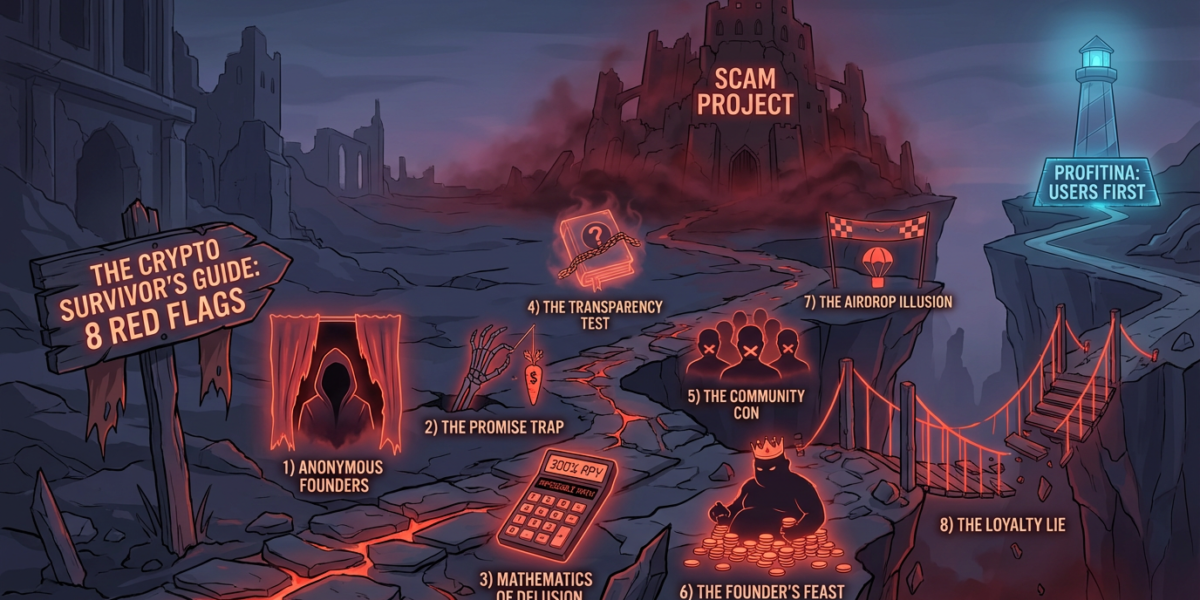
From the stories of dozens of victims and analyzing hundreds of failed projects, a clear pattern emerges. Think of this discussion as the scammer’s playbook—8 deadly sins that separate legitimate projects from elaborate traps.
1. The Identity Crisis
If you can’t find them, don’t trust them. That is the first and most critical red flag: anonymous founders who operate in the shadows.
Real innovators in tech and finance don’t hide. Elon Musk takes your calls (well, your tweets). Vitalik Buterin speaks at conferences. The legitimate builders in this space put their faces and reputations on the line because they believe in what they’re creating.
When founders are unreachable ghosts? Run.
2. The Promise Trap
Remember when your uncle promised you that “sure thing” investment? Yeah, that feeling.
Failed crypto projects share a distinctive trait: they promise the moon but deliver dust. “Coming soon” becomes their favorite phrase—a perpetual carrot dangling just out of reach.
Take the leading mobile-mining experiment project as a cautionary tale. Seven years after its debut, millions of users are still waiting for basic functionality to exist outside of its closed doors. Seven years—that is more time than it took to build the entire Empire State Building from the ground up.
3. The Mathematics of Delusion
Here’s a simple rule: if the returns sound too good to be true, they are.
Projects offering 50%, 100%, or even 300% APY aren’t financial innovations—they’re mathematical impossibilities trying to disguise themselves as opportunities. Real, sustainable yields in crypto typically range from 5-20% annually. Anything beyond that requires a level of scrutiny that would make a forensic accountant sweat.
The question that cuts through every pitch is simple: show me the business model. If a project cannot explain where the returns come from, they are probably coming from the next person’s deposit.
4. The Transparency Test
Legitimate projects operate like open books. They publish detailed whitepapers. They make their smart contracts public. They communicate constantly with their community.
Scam projects? They operate in the fog. Vague documentation. Locked smart contracts. Radio silence when questions get tough.
Think of transparency as oxygen. If a project can’t breathe in the open air of public scrutiny, it’s probably toxic.
5. The Community Con
Watch how a project treats criticism. Healthy projects welcome constructive feedback. They see engaged critics as free consultants helping them improve.
Scam projects? They ban, delete, and silence. Discord moderators work overtime removing “FUD” (Fear, Uncertainty, Doubt)—which often translates to “legitimate questions we can’t answer.”
When dissent is treated as treason, you’re not in a community—you’re in a cult.
6. The Founder’s Feast
Look at the tokenomics. How much does the founding team take?
In legitimate projects, founders typically receive 10-20% of tokens, often with multi-year vesting schedules. This aligns their interests with yours—they only win if you win.
In scams? Founders gorge themselves on 40%, 50%, even 60% of the supply. They’re not building for the long term. They’re planning their exit.
7. The Airdrop Illusion
The promised day arrives. Months of grinding, clicking, and referring. Finally, your rewards are coming.
Then the goalpost moves. New requirements. Additional verification. Unexpected delays. The airdrop that was “coming soon” needs just one more thing. And another. And another.
This isn’t incompetence—it’s strategy. Keep you engaged. Keep you hopeful. Keep you from realizing you’re being played.
8. The Loyalty Lie
Failed projects share another trait: they’re unfaithful.
They launch one initiative, generate hype, then abandon it for the next shiny thing before delivering results. They’re opportunistic, prioritizing developer profits over user value. They treat retail investors like fuel for their bonfire of greed.
When a project doesn’t finish what it starts, it’s telling you everything you need to know about its future.
A Different Blueprint
Amid this landscape of broken promises, some projects try something radical: making the checklist above a design constraint rather than a marketing slogan.
Profitina is one attempt. It is not a trading platform and not a yield product — it is an AI-visibility (GEO) platform: it measures how AI answer engines such as ChatGPT, Gemini, and Perplexity represent and cite a brand, then helps improve it. Contribution to the community is acknowledged with PROFIT, a utility coin. Here is how it maps against the eight red flags:
Identity: A named founder with a public profile and a working contact address — [email protected].
Promises: The platform went live in production first, in July 2026, and the claims came after. What is not finished is labelled as not finished.
Returns: There are none to promise — and that is the point. PROFIT is a utility coin, not an investment: no APY, no yield, no return of any kind. Earnings are deliberately tiny and capped per day — 0.01–0.05 for scan feedback, 0.02 for a post, 0.01 for a reply — and the emission rate decays as the user base grows, so supply cannot inflate. Selling or redeeming PROFIT for rupiah is disabled.
Transparency: The whitepaper is public in English and Indonesian. The token is already issued and verifiable on Solana devnet — mint 6f1dNQPhYXPo78LVLGD2WpzBH2mzCm77BG9E8PFnWweL, 6 decimals, freeze authority disabled from the start, so nobody’s balance can be frozen. Anyone can inspect it on a block explorer today.
Founder’s share: The 10-billion supply cap is locked, and the allocation is published in the whitepaper rather than discovered later.
Airdrop: There is no airdrop, so there is no moving goalpost. Only verified humans earn anything — email verification is mandatory, and Profitina’s own self-hosted AI scores whether a contribution is actually useful. Bot-generated content is worth exactly 0.00, and PROFIT awarded to activity later proven to be automated is clawed back and burned.
Community: Feedback is a paid, five-step, publicly tracked pipeline — not a channel to be moderated into silence.
Does this guarantee success? Of course not. Building in this space is brutally difficult, and execution matters far more than intentions. Profitina is still on testnet, is not licensed by Indonesia’s OJK, and any rupiah figure it shows is a model estimate rather than a market price.
But it demonstrates that a different shape is possible — one where the honest answer to “what will I earn?” is “almost nothing, and we will tell you exactly why.”
Your Survival Checklist
Before investing in any crypto project, ask yourself:
- Can I find and contact the founders?
- Does the product actually exist, or is it just promises?
- Are the returns mathematically possible?
- Is there a detailed, public whitepaper?
- Can I see the smart contract code?
- How does the project treat criticism?
- What percentage of tokens do founders control?
- Is the project finishing what it starts?
- Are they compliant with regulations?
- Do they prioritize community or insiders?
If you can’t confidently answer “yes” to most of these, walk away. Your future self will thank you.
The Bottom Line
The crypto industry doesn’t need more hype. It needs more honesty.
It doesn’t need more promises. It needs more delivery.
It doesn’t need more extraction. It needs more alignment.
Jessika Walker learned these lessons the expensive way. You don’t have to.
In a world of digital gold rushes, the real fortune isn’t in finding the next 100x token. It’s in not losing everything to the scam that promised it.
Do your research. Trust your instincts. And remember: in crypto, as in life, if something seems too good to be true, it’s probably because someone’s lying to you.
*Editor’s note (31 July 2026): the “A Different Blueprint” section was rewritten. An earlier version described Profitina as a social-finance platform and quoted an APY range — inaccurate after our repositioning as an AI-visibility (GEO) platform, and inconsistent with our own rule against publishing return figures. The illustrative names in this article are composites, not real individuals.*
Disclaimer: This article is for educational purposes only and does not constitute financial advice. Cryptocurrency investments carry significant risk. Always conduct your own research and only invest what you can afford to lose.