
Book
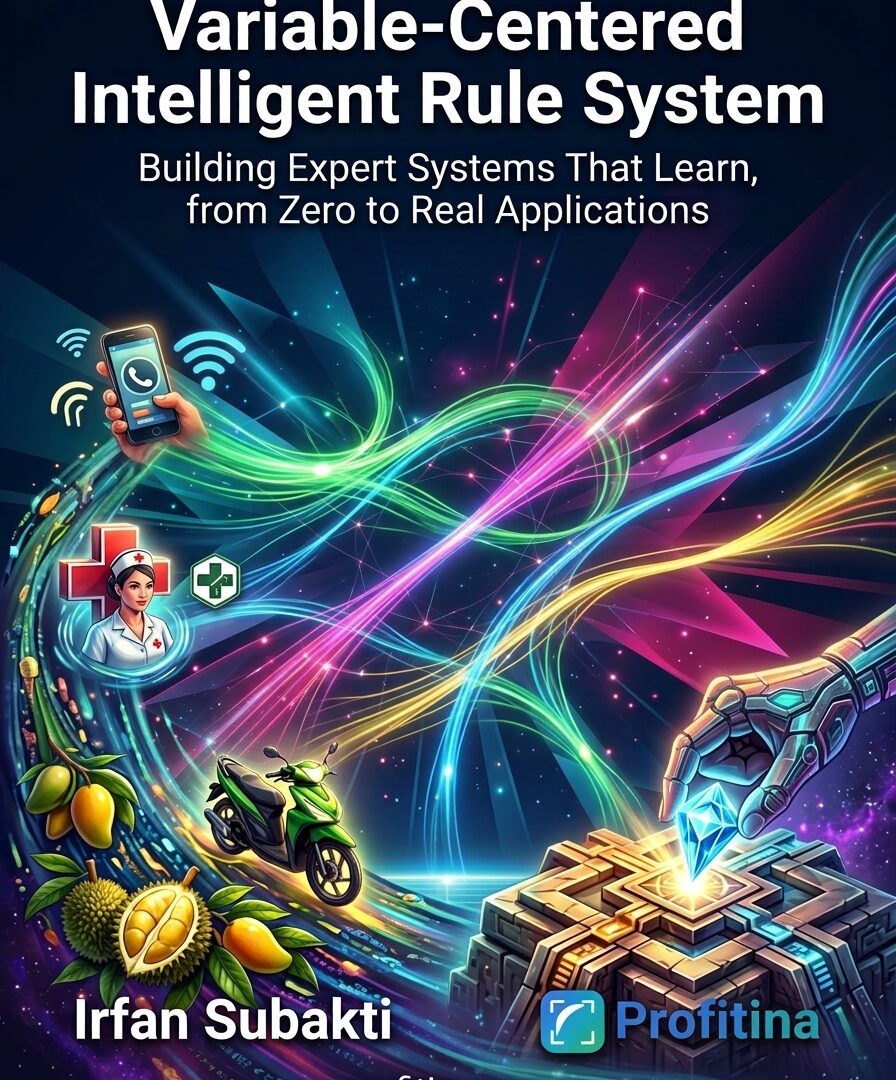
Variable-Centered Intelligent Rule System: Building Expert Systems That Learn, from Zero to Real Applications
Building Expert Systems That Learn, from Zero to Real Applications — A phone-counter owner who knows which question to ask first, a nurse at the puskesmas who knows which fever cannot wait, a mechanic at the ojek base camp who hears a weak horn and already suspects the battery: each of them carries knowledge that can be written as rules. If this and this, then that — unless that other thing is true. Nobody learned those rules from a book.
Overview
Chapter 1 looks at the rules that already run an ordinary morning, explains what makes a set of rules intelligent and how the three families — classic rule-based systems, Ripple Down Rules and VCIRS — fit together, and sets up the workbench: VS Code, JDK 25 and Python 3.14 on Windows, macOS and Linux. It ends with a first taste of VCIRS, a tiny knowledge base that learns an exception to its own rule.
Chapters 2 to 5 lay the foundations. Chapter 2 helps Bu Sri keep her family’s electricity bill under four hundred thousand rupiah with the first rule program of the book: IF–THEN advice kept apart from the program, each piece with its reason and its saving in rupiah. Chapter 3 builds a phone and Wi-Fi troubleshooter for Mas Anto’s counter in the market with Ripple Down Rules, first by hand and then on vcirs-core, so that it learns the right fix every time its advice fails. Chapter 4 helps Laras and her school counselor, Bu Wati, think about study programs, and in doing so introduces the heart of VCIRS: advice turned into variables, values, conditions, nodes and rules, kept in the Variable-Centered Rule Structure. Chapter 5 builds a health self-check that asks the safety questions first and says plainly when to see a doctor, and lets the nurse at the puskesmas refine its knowledge case by case with the list of difference, the cornerstone cases and the six options of VCIRS.
Chapters 6 to 9 are about what makes VCIRS intelligent. Chapter 6 helps Pak Slamet with the troubles of his durian, mango, chili and rice, computes the Variable, Node and Rule Usage Rates, and uses them to generate new, more general rules that the village extension worker reviews before keeping. Chapter 7 routes the WhatsApp messages of a neighborhood shop to the right person in the family and reads the Credit and usage statistics the way a shopkeeper would. Chapter 8 gives ojek drivers a motorcycle fault finder that rules out danger first, reasons forward and backward over IF–THEN rules drawn from the knowledge base, and answers what, how and why. Chapter 9 prepares the monthly meeting of a savings-and-loan cooperative with a fuzzy VCIRS that understands low, medium and high, warns when a case is borderline, and refuses to learn from protected attributes.
Chapters 10 to 13 take the knowledge out into the world. Chapter 10 puts a laundry’s stain-removal advisor on the web, with its knowledge base in a SQLite database, served by a Java and a Python server that answer with the same bytes. Chapter 11 lets the team of a small clinic keep a triage knowledge base together, with proposals, tests on golden cases, a second expert’s review, versions and an audit trail chained with SHA-256. Chapter 12 learns rules from data, growing a decision tree from a table of animals and turning it into a VCIRS knowledge base that a biology teacher then refines. Chapter 13 lets customers talk to the Wi-Fi doctor in their own words through a local language model, while the knowledge base, checked by a person, makes every decision and a guard rejects any reply it does not back.
Chapter 14 is the capstone: a web application with which someone who has never programmed — Bu Wati the cake maker, with eleven years of notes in an exercise book — builds an expert system of her own, teaches it case by case, reads its usage statistics and accepts or ignores the rules it proposes. Chapter 15 keeps such systems alive: an advice service packaged as one file, automatic checks, backups that can be trusted, a usage log that records the advice and not the people, a monthly report that says what to teach next, and Indonesia’s personal data protection law.
Every chapter follows the path a real project takes: the problem and who it helps, the idea in plain words, the application built step by step, running it, making it better, using it for real in your own shop, farm, clinic or house, common mistakes, a summary, exercises with complete solutions, and references. Where an application gives advice about health, money or safety, it says plainly when to see a doctor, a midwife, a mechanic or the people who decide.
Every program in this book was run before its output was printed. The programs are collected, chapter by chapter, in the accompanying Code folder, from Chapter01 to Chapter15, each with a java and a python folder, the data it needs, and a README that explains how to run it in a terminal and in VS Code on Windows, macOS and Linux; the shared engine sits beside them in vcirs-core.
Inside the Book
- Intelligent Rules in Daily Life, and Your Workbench
- Electricity-Bill Saver: Your First Rule Program
- Phone and Wi-Fi Troubleshooter That Learns from Each Fix
- Study-Program Advisor: Thinking in Variables
- Health Self-Check Advisor: Case-by-Case Knowledge Refinement
- Crop and Fruit-Tree Problem Advisor for Farmers: Rule Generation
- Small-Shop Customer-Message Router: Usage and Credit Statistics
- Motorcycle Fault Finder for Ojek Drivers: Forward and Backward Inference with Explanations
- Cooperative-Loan Eligibility Advisor: Fuzzy VCIRS
- Laundry Stain-Removal Advisor as a Web App with a Database
- Clinic Triage Knowledge Base for a Team: Many Experts, Versions and Audit
- Learning Rules from Data: From a Decision Tree to a VCIRS Knowledge Base
- Talking to Your Expert System: a Local Language Model with Human-Checked Knowledge
- Capstone: a VCIRS Expert-System Builder Anyone Can Use
- Deploying, Maintaining and Growing Your Expert Systems
Profitina · profitina.com