
A New Approach to Connecting Capital with Opportunity—But Can It Deliver?
In a modest office space somewhere in the digital ether, a small team is building what they hope will become a bridge across one of business’s most persistent divides: the gap between those who have capital and those who build value.
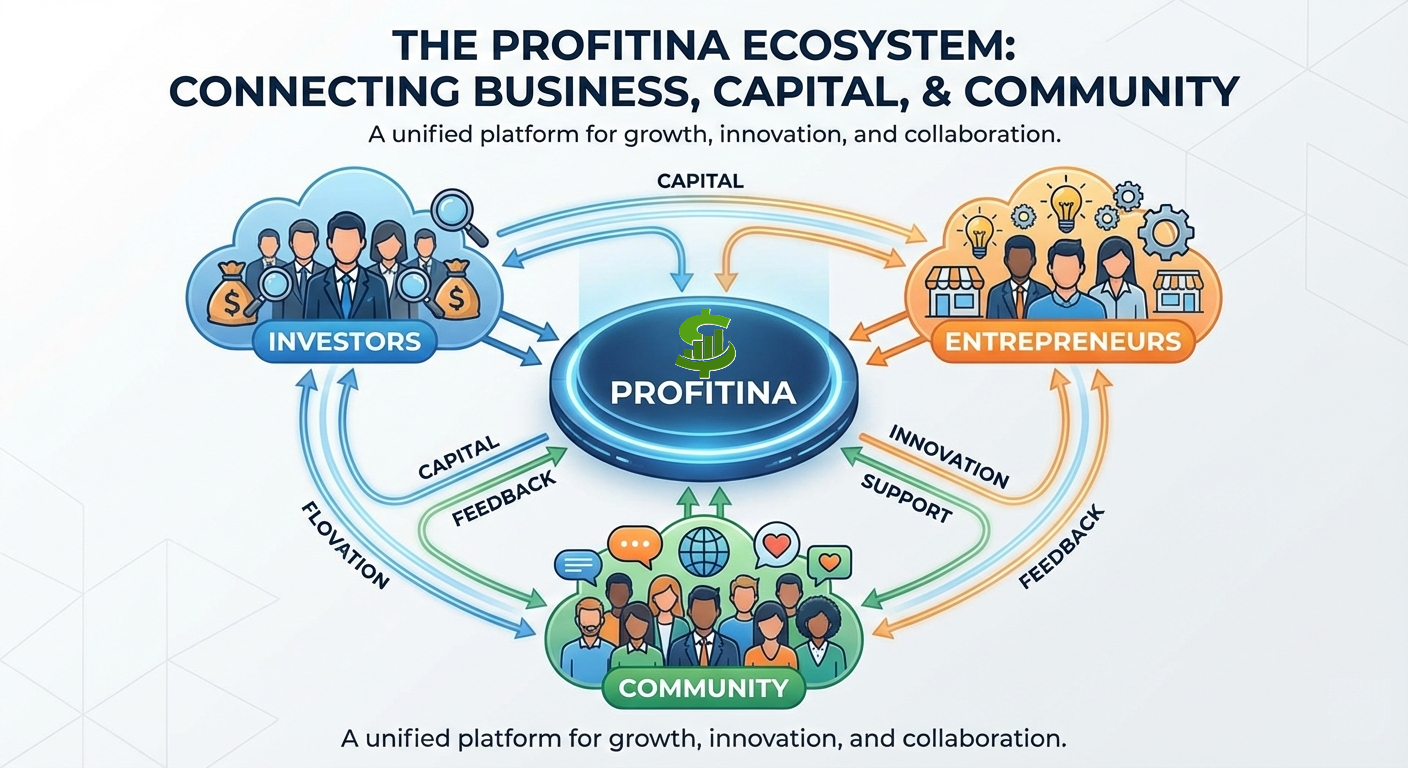
Profitina, a platform still in its development phase, represents an ambitious attempt to create something the business world has long needed but rarely achieved—a single space where traditional brick-and-mortar businesses, digital ventures, and blockchain projects can all seek funding, where investors can explore opportunities across sectors, and where communities can engage meaningfully with both.
It’s a noble vision. Whether it’s achievable remains to be seen.
The Problem They’re Trying to Solve
The challenge is real enough. Ask any entrepreneur about raising capital, and you’ll hear familiar frustrations: investors focused only on tech startups, funding platforms that exclude traditional businesses, barriers to entry that keep out all but the well-connected.
Ask investors, and you’ll hear different complaints: too many platforms serving narrow niches, difficulty finding quality opportunities outside their usual circles, lack of transparency in early-stage ventures.
“We kept seeing the same pattern,” says the Profitina team in their materials. “Good businesses exist everywhere—in retail shops, digital platforms, blockchain protocols. But capital tends to flow through established channels, often missing opportunities that don’t fit conventional categories.”
Their solution? Build a platform that doesn’t discriminate by business model.
What They’re Actually Building
Profitina’s team doesn’t oversell what they have. Currently, they’re working with a very rough prototype and a roadmap of ideas. The vision includes project listings, investor-entrepreneur messaging, educational resources, mobile apps, analytics tools, payment integrations, and matching systems—but most of this is still in the planning phase.
The platform operates across three distinct business universes:
Traditional Business: The coffee shop seeking expansion capital. The small manufacturer needing equipment financing. The service business looking for growth funding. These are businesses that typically struggle to access venture capital, which tends to favor high-growth tech companies.
Digital Business: SaaS platforms, e-commerce ventures, mobile applications. This is more familiar territory for most funding platforms, but Profitina aims to make it more accessible to smaller players and first-time founders.
Blockchain & Web3: DeFi protocols, NFT projects, tokenized assets. Here’s where things get technically complex and, some would argue, risky.
The Hybrid Approach
What makes Profitina potentially interesting is its hybrid architecture. For internal operations—user profiles, messaging, project browsing—everything happens in a traditional database. Fast, free, familiar.
But for certain financial operations, particularly those involving cryptocurrency, the platform integrates with Solana blockchain. The choice of Solana over Ethereum or other networks is pragmatic: transactions cost fractions of a penny rather than dollars, and settlements happen in under a second rather than minutes.
“We’re not blockchain maximalists,” the team acknowledges. “We use it where it makes sense. For a retail shop owner seeking a business loan, blockchain adds nothing. For a DeFi protocol raising liquidity, it’s essential.”
This pragmatism extends to their business model. Unlike many platforms that take equity stakes or charge steep listing fees, Profitina plans to operate on modest transaction fees (0.15-0.3% on trades) and service charges.
The Elephant in the Room: Regulation
Here’s where the story gets complicated.
Operating a platform that facilitates investment across multiple jurisdictions, multiple asset types, and multiple regulatory frameworks is legally treacherous. Securities laws vary dramatically by country. What’s permissible in Singapore might be illegal in the United States. Cryptocurrency regulations remain in flux globally.
When asked about regulatory compliance, the team is notably cautious: “We’re building toward compliance, not claiming we’ve achieved it. We’re not operating as a registered broker-dealer or investment advisor. We’re a platform for information sharing and business networking. Users are responsible for their own compliance with local laws.”
This is honest, but it’s also a potential red flag. The line between “information sharing platform” and “unregistered securities exchange” has proven difficult for many startups to navigate. The SEC and equivalent bodies worldwide have shown increasing willingness to crack down on platforms that facilitate investment without proper licensing.
The Community Angle
One genuinely interesting aspect of Profitina is its focus on community engagement beyond just matching investors with entrepreneurs.
The platform includes educational content, discussion forums, and what they call “social-to-earn” features—users can earn small amounts of the platform’s PROFIT token by contributing quality content, providing thoughtful feedback on projects, or helping test new features.
It’s a model borrowed from Web3 social platforms, applied to business networking. Whether it actually fosters quality engagement or just creates noise remains to be seen.
Dr. Sarah Chen, a professor of entrepreneurship at Stanford who studies crowdfunding platforms, offers measured optimism: “The idea of creating a more inclusive funding ecosystem is laudable. The challenge is execution. Community-driven platforms work when they maintain quality. That requires active moderation, clear standards, and often, gatekeeping—which conflicts with the ‘open to all’ ethos.”
What They’re Not Promising
In an era of startup hyperbole, Profitina’s restraint is almost jarring. Their materials explicitly state they cannot promise:
- Guaranteed returns on any investment
- Overnight success for any business
- Risk-free opportunities
- Funding for every entrepreneur who applies
They’re also frank about their current limitations: “We’re early. Our mobile apps are in beta testing. Some features exist only as concepts. We’re learning as we go.”
This honesty is either commendable transparency or a sign they’re underprepared. Possibly both.
The Sustainability Question
Can a platform like this actually survive financially?
The math is challenging. With transaction fees of 0.15-0.3%, Profitina needs substantial volume to generate meaningful revenue. Assuming they facilitate $1.2 billion in annual transaction volume (their planned year-one target), that’s roughly $3.6 million in revenue.
For context, that’s barely enough to support a team of developers, compliance officers, and customer support staff—let alone marketing, infrastructure costs, and legal fees.
The team acknowledges this: “We’re not building this to get rich quickly. We’re building for sustainability over time. If we can create real value for users, the business model will work.”
Investors in the startup space might call this naive. Others might call it refreshing.
Real People, Real Stakes
Behind the technical architecture and business models are real people making real decisions with real money.
Maria Santos, a small restaurant owner in Manila, represents the kind of user Profitina hopes to serve. “Banks won’t give me a loan for expansion. My business is profitable, but I don’t fit their criteria. A platform like this could help—if it works, if it’s real, if investors actually look at traditional businesses.”
On the investor side, James Wong, an angel investor in Singapore, expresses cautious interest: “I’m tired of seeing only SaaS pitches. I’d like to invest in good businesses regardless of category. But I need proper due diligence, legal protection, and confidence the platform itself is legitimate. That’s what I’m waiting to see.”
The Broader Context
Profitina enters a crowded market. AngelList, SeedInvest, Fundrise, and dozens of others already connect investors with opportunities. In the crypto space, platforms like DAO Maker and TrustSwap facilitate token launches.
What Profitina claims as unique is its cross-category approach. But uniqueness alone doesn’t guarantee success.
The platform also faces headwinds. Rising interest rates make risk capital scarcer. Cryptocurrency skepticism remains high following multiple exchange collapses. Small businesses face economic uncertainty.
Yet there’s also genuine need. Traditional funding channels remain gatekept and exclusive. Many good businesses struggle to access capital. Many investors seek diversification beyond public markets.
What Success Would Look Like
If Profitina succeeds, we might see:
A café owner in Jakarta securing growth capital from an investor in Toronto who believes in the business model. A mobile app developer in Lagos connecting with advisors in Silicon Valley who provide more than just money. A DeFi protocol finding liquidity from institutional investors who actually understand the technology.
More importantly, we might see a reduction in the geographic and categorical barriers that keep capital and opportunity apart.
But success requires more than good intentions. It requires robust technology, sound legal frameworks, active community moderation, and perhaps most importantly, trust—the hardest currency to earn and the easiest to lose.
The Verdict: Potential with Caveats
Profitina is attempting something genuinely useful: creating a more democratic, inclusive funding ecosystem. Their transparency about limitations and refusal to overpromise is admirable.
But they face formidable challenges: regulatory complexity, market competition, the difficulty of serving multiple constituencies well, and the basic problem of achieving scale.
For investors: This is not a platform to bet your retirement on. If it succeeds in facilitating quality connections and maintains proper safeguards, it could become a useful tool for portfolio diversification. Approach with appropriate skepticism and never invest more than you can afford to lose.
For entrepreneurs: A platform like this could provide access to capital you wouldn’t otherwise reach. But don’t count on it as your only option. Continue pursuing traditional funding channels while exploring this as a supplement.
For communities: If you’re interested in learning about business and investing, the educational aspects could have value. Just remember: no platform can eliminate the fundamental risks of investing.
The team behind Profitina deserves credit for tackling a real problem with honesty and restraint. Whether they can execute on their vision while navigating the regulatory, technical, and competitive challenges ahead—that’s the story still being written.
In the end, platforms like this succeed or fail based on one simple metric: Do they create genuine value for real people? Everything else is commentary.
We’ll be watching.
Disclosure: This article does not constitute investment advice. All investments carry risk.