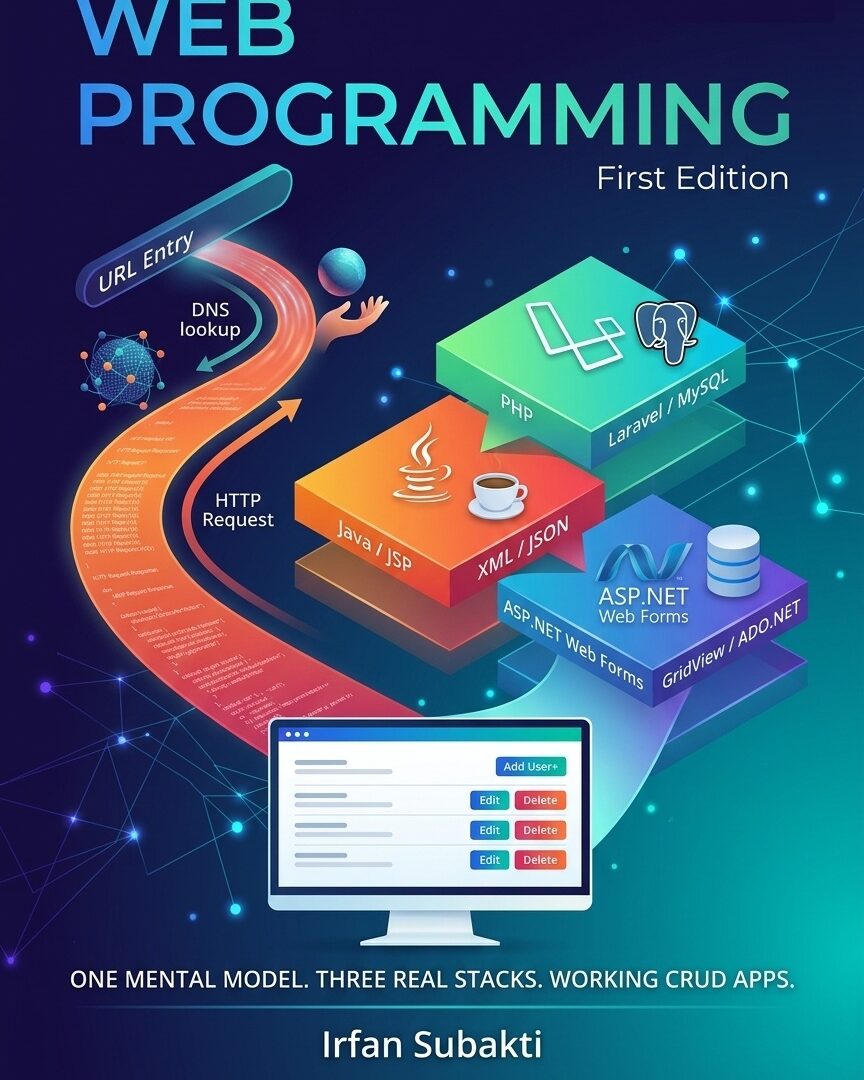
Before a single line of PHP, JSP, or C# is written, this book grounds every chapter in one clear mental model: what actually happens between typing a URL and a page rendering on your screen — then proves that model by building the same CRUD application three separate times, once per stack.
Overview
Web Programming (WebPro) opens with the client-server model and the HTTP request-response cycle — DNS lookups, requests, responses — and HTML, CSS and JavaScript fundamentals, closed out with a real take-home website project. It then runs the same core exercise three times over in three different technology stacks: PHP with MySQL (moving from raw PHP to the MVC pattern via Laravel), Java with JSP (fundamentals, a full CRUD walkthrough, and XML/JSON data handling), and ASP.NET Web Forms (GridView, ADO.NET, validation, and state management). Each stack closes with its own small, real take-home project — Quiz 1, a Midterm, Quiz 2, and a Final Exam — so the course is graded on working applications, not multiple-choice recall.
What You Will Learn
- Explain precisely what happens between typing a URL and a rendered page — DNS resolution, the HTTP request-response cycle, client vs. server responsibilities.
- Structure content with HTML and style and script it with CSS and JavaScript.
- Build a working PHP + MySQL CRUD application, and see why an MVC framework like Laravel exists.
- Build the same kind of application again with Java JSP, including working with XML and JSON.
- Build it a third time with ASP.NET Web Forms, using GridView, ADO.NET, validation, and state management.
- Compare three real web stacks by having actually built the same problem in each one, not by reading about them.
Inside the Book
- Foundations of the Web: How a Web Page Actually Gets to Your Screen — DNS, HTTP, and the client-server model, before any code.
- HTML: Structuring Content for the Web — semantic markup as the skeleton every later chapter builds on.
- CSS & JavaScript Basics — styling and first interactivity in the browser.
- Quiz 1: A Small, Real Take-Home Website Project — a real static-site build, graded as working software.
- PHP Basics — server-side scripting fundamentals.
- PHP + MySQL — a first real database-backed CRUD application.
- PHP MVC & Laravel — why structure matters once an application grows, introduced through Laravel.
- Midterm: A Small, Real Take-Home PHP + MySQL + MVC Project — the PHP track’s capstone exercise.
- JSP Fundamentals — the same web-application problem, restarted in Java.
- JSP CRUD Walkthrough — a complete CRUD application built step by step in JSP.
- XML & JSON — structured data exchange between systems.
- Quiz 2: A Small, Real Take-Home JSP Project — the Java track’s capstone exercise.
- ASP.NET & Web Forms — the third stack, and Microsoft’s take on server-side web development.
- GridView & ADO.NET — displaying and editing database data the ASP.NET way.
- Validation & State Management — keeping a Web Forms application correct and coherent across requests.
- Final Exam: A Small, Real Take-Home ASP.NET Web Forms Project — the course’s closing capstone, across the third stack.